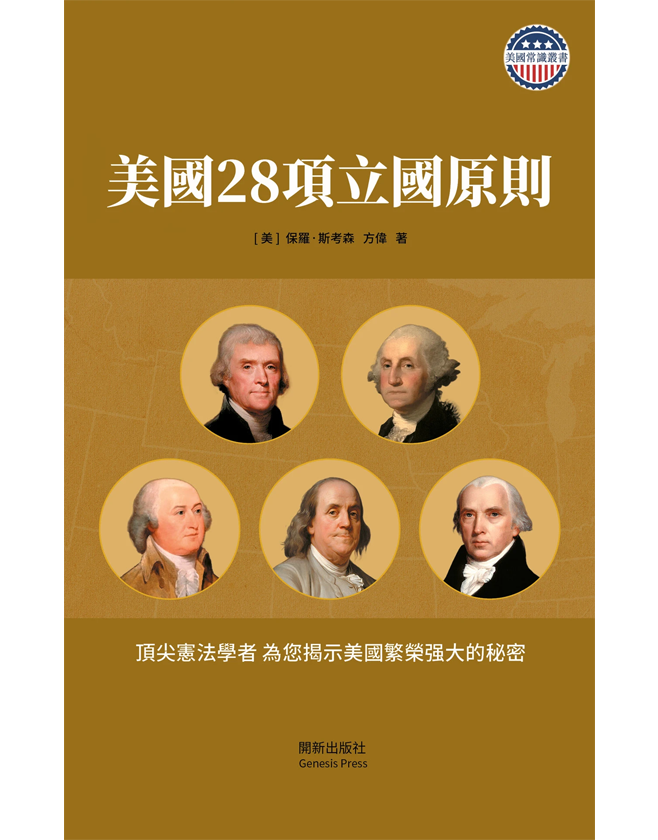
The 28 Founding Principles of America: Illustrated Collector's Edition Paperback (Hand-Revised)
The 28 Founding Principles of America: Illustrated Collector's Edition Paperback (Hand-Revised)
Couldn't load pickup availability
Endorsements

"How do we tell our children what kind of country America should be and where our future lies? ...I am so glad that the Chinese edition (of The 28 Principles of America's Founding) is finally available. I hope everyone can own a copy so we can discuss it with our children at the dinner table."
—Jiang Feng, host of the renowned political commentary program "Jiang Feng Moment"
"The American system perfectly guarantees the nation's internal benevolence and external strength... I believe readers will draw more wisdom from this book, The 28 Principles of America's Founding, and understand the true reasons why America is great."
—Zhang Tianliang, Associate Professor, Department of Humanities and Sciences, Fei Tian College
About the Book
America's prosperity and strength were not accidental or coincidental, but rather the result of the Founding Fathers discovering the secret to America's success at the Constitutional Convention in 1787. So, can anyone clearly explain this secret? In 1783, after seven years of brutal war for independence, the newly born United States faced internal and external challenges, with a dismal economy. However, by 1905, the U.S. had developed into the wealthiest industrialized nation in the world. After World War II, the U.S. became an undisputed superpower. Dr. Cleon Skousen, a renowned American constitutional expert and author, compiled these secrets to success into a book that became a long-standing classic bestseller. This book is an abridged version of the original English work.
About the Authors

Paul Skousen is an American constitutional scholar, author, and university professor with extensive and in-depth research on the U.S. Constitution and the socialization of America. He served in the CIA and as a White House intelligence officer for President Reagan. He holds a master's degree in National Security Studies from Georgetown University and a journalism degree from Brigham Young University. He has authored 15 books.
Fang Wei is a veteran media professional, American common sense scholar, and high-tech expert. With over 30 years in the technology and media industries, he has founded multiple media and tech companies. He hosts and participates in "Fang Wei Time," "Into America," and the large-scale history program "A Story of America," with deep research into American history and contemporary affairs. Fang Wei graduated from Fudan University in Shanghai and earned a master's degree in computer science from the University of Iowa in the United States.
Foreword
In 1783, after seven years of brutal war for independence, the United States was born. However, it faced internal and external challenges, with a bleak and hopeless future.
At that time, the U.S. central government was weak and powerless, the economy was dismal, the treasury was empty, and debts were mounting. Veterans were waiting for the government's promised compensation, but the paper money issued by the government was worthless. Many Americans were deeply in debt and unable to repay. Starting in Boston, debtors rebelled due to pressure from creditors; when laws to protect debtors were introduced, they angered creditors, leading to another wave of unrest.
The American states were disunited and plagued by trade disputes; New England in the northeast even threatened: "We want independence!" Meanwhile, Britain, which ruled Canada, and Spain, which occupied Florida, watched covetously, ready to swallow any land that might secede from the U.S.
On April 25, 1787, 55 delegates from 13 states gathered in Philadelphia for the U.S. Constitutional Convention. They are known to posterity as the Founding Fathers of America.
In hot Philadelphia, they locked themselves in a house with sealed windows and doors for an entire summer. Four months later, on September 17, they finally drafted a new U.S. Constitution.
The states gradually ratified the new Constitution over two years. Then, according to the Constitution, the Founding Fathers established the U.S. federal government, including the President, Congress, and Supreme Court, and clearly defined their respective powers. In 1789, George Washington was elected as the first President of the United States.
Two years after the new federal government took office, America was completely transformed. Riots ceased, the economy stabilized, people were busy with production, and inventions were constant. The young federal government quickly established extremely high credibility, much to President Washington's own surprise.
From then on, the United States embarked on a path of prosperity and strength for over 200 years. By 1860, the U.S. was a world leader in consumer markets, railway transportation, and industrialization.
By 1905, the United States had become the wealthiest industrialized nation in the world, producing over 50% of the world's mid-to-high-end goods, including clothing, food, new homes, transportation, communication equipment, and various luxury items, with only 6% of the world's population.
After World War I and World War II, the United States became the undisputed world leader and superpower, leading global trends; the U.S. Constitution also became a model for contemporary democratic nations.
America's success was not luck or coincidence, but rather the result of the Founding Fathers discovering the secret to America's success at the Constitutional Convention in 1787. So, can anyone clearly explain this secret?
In the early 1930s in Washington D.C., a young man in his early twenties worked for the FBI during the day and studied law at George Washington University at night. He was astonished to find that there was no textbook that could concisely explain the Constitution. He also noticed that new congressmen, elected from various professions, did not understand the Constitution and began frequently enacting laws that deviated from it.
This young man was Cleon Skousen. He later earned a Doctor of Jurisprudence degree and became a renowned American constitutional expert and author. In his quest for this textbook, he read over a hundred books related to the Founding Fathers, thousands of pages of federal papers, Founding Fathers' autobiographies, published articles, and correspondence. In his reading, he discovered that some important principles reappeared repeatedly. So, he recorded them one by one and eventually wrote a book titled "The 5000 Year Leap: Twenty-eight Great Ideas That Changed the World."
In the preface to his book, Dr. Skousen wrote: "Never have I felt such gratitude for their great character and wisdom... I felt the secret that enabled the Founders to make America free and prosperous."
However, today, more than 200 years later, these founding principles of America have gradually been forgotten, and the United States has gradually fallen into a great crisis—the two major political parties, one left and one right, hold their own views and are irreconcilable. If this deterioration continues, where will America go?
In the winter of 1778, Washington's Continental Army lost Philadelphia during the War of Independence and was trapped in Valley Forge, Pennsylvania. There, he received a divine revelation: "So long as there are stars in the sky and dew on the ground, the Union shall endure!"
So, how can this crisis be resolved to ensure America's eternal existence? The answer is simple—let America return to its founding principles. This is not only the "golden key" to America's triumph over adversity but also a path to prosperity and strength worth emulating for other nations.
To enable freedom-loving Chinese friends to grasp this "golden key," we have specially published this book, "The 28 Principles of America's Founding." The book retains the essence of the original work, reducing its length to less than one-third of the original, with more accessible language. You can easily read it in half a day.
Now, let us embark on this journey to discover America's roots together.
Paul Skousen, Fang Wei
Table of Contents
What Kind of Good Government Did the Founding Fathers Design?
First Founding Principle: Establishing Government and Society Based on Natural Law
Second Founding Principle: Virtue is Essential for Liberty
Third Founding Principle: Electing Leaders of Virtue and Talent
Fourth Founding Principle: Correct Beliefs Ensure Long-Term National Stability
Fifth Founding Principle: Trusting God for Divine Protection
Sixth Founding Principle: All Men Are Created Equal
Seventh Founding Principle: Guaranteeing Equality of Rights, Not Equality of Outcomes
Eighth Founding Principle: Everyone Enjoys Inalienable Natural Rights
Ninth Founding Principle: Following Natural Law to Protect Human Rights
Tenth Founding Principle: Popular Sovereignty
Eleventh Founding Principle: The Right of the People to Overthrow Tyranny
Twelfth Founding Principle: America Should Be a Republic
Thirteenth Founding Principle: Guarding Against the Weakness of Human Nature in Those in Power
Fourteenth Founding Principle: Protecting Property Rights to Safeguard Life and Liberty
Fifteenth Founding Principle: Implementing a Free Market Economy to Create Prosperity
Sixteenth Founding Principle: Separation of Legislative, Executive, and Judicial Powers
Seventeenth Founding Principle: Using Checks and Balances to Prevent Government Abuse of Power
Eighteenth Founding Principle: Codifying Governing Principles in a Written Constitution
Nineteenth Founding Principle: Granting Limited Power to the Government, Reserving the Rest for the People
Twentieth Founding Principle: Majority Rule, But Protecting Minority Rights
Twenty-First Founding Principle: Maintaining Strong Local Self-Governance
Twenty-Second Founding Principle: Rule of Law, Not Rule of Man
Twenty-Third Founding Principle: Promoting Education in Faith, Morality, and the Constitution
Twenty-Fourth Founding Principle: Seeking Peace Through Strength
Twenty-Fifth Founding Principle: Treating All Nations Kindly But Forming No Alliances
Twenty-Sixth Founding Principle: Protecting the Family to Stabilize Society
Twenty-Seventh Founding Principle: Avoiding Debt
Twenty-Eighth Founding Principle: Manifest Destiny—Becoming a Beacon of Liberty
Book Details
Publisher: Genesis Press, USA
ISBN: 978-1-963236-13-2
Pages: 238 pages
Text Language: Traditional Chinese
Publication Date: First Edition released October 2, 2024
Shipping Information
Thank you for your purchase! We will ship your paperback book from our New York warehouse within 1-3 business days after payment, typically delivering within 2-8 business days.
Once your paperback book has shipped, you will receive a tracking number to monitor its delivery progress. If you do not receive your order within the usual delivery time, please contact us for assistance.
If you find that your package is damaged in transit, please refuse to accept it and contact us; if the package is damaged and delivered when you are not present, please also contact us as soon as possible for assistance.
Return and Exchange Policy
You may return ordered items within 14 days of receipt without any reason, provided that we confirm the item is unused and undamaged. You will also need to provide a receipt and bear the double postage costs incurred for shipping and return.
If you find that we have mailed a defective or incorrect item, please contact us as soon as possible with photos of the item. Upon our approval, you may return or exchange it.
Electronic products such as e-books, audiobooks, and videos, as well as special offer items, or items that have been opened or used, are not eligible for return.
For return and exchange procedures and other details, please refer to the Refund Policy page.
If you have any questions or difficulties during your shopping experience on this website, please feel free to contact us. We will do our best to assist you. Customer service email: contact@genesispress.org